Showing posts with label history. Show all posts

Tuesday, June 12, 2007

Bayon

There are many smaller temples scattered around the area of Angkor Wat. You could easily spend a week visiting them all – if you could stand the heat – but we only had three days, so we tried to choose carefully.

One popular favorite which we were sure not to miss is Bayon, the “faces” temple. More than one hundred giant faces have been counted carved into the stone around this temple, with a variety of different emotional expressions.

You enter Bayon by crossing a bridge lined with demons on one side and “good” gods on the other. They are having a tug-of-war.


Then you have to pass through a huge gate. Can you see the faces?


Much of the temple is filled with extensive, detailed carvings, showing scenes ranging from fantastic battles to ordinary, daily life.


You can see some places where the temple has definitely turned to ruins.


Happy? Or something else?

One piece of info: at Bayon, and at a few other temples, we found that if we wandered away from the large groups of tourists to less crowded areas, often at the back of the temple, we would encounter local youth who spoke very good English and tried to get us to give them money. They would usually say they were raising it for their English school. Sometimes they would start giving us a “tour” of the temple, and then would expect us to give them money in return. We had no idea if they were legit or not, and didn’t want to be pulling out our wallets in the woods with no one else around, so we didn’t give any money, but it was often difficult to walk away, as they would continue to follow us, talking. I doubt we were actually in any danger, but it did make us uncomfortable, and after the first couple of times we opted to just stay near other tourists.

Friday, May 18, 2007

Angkor Wat

So much has been written about the temples of Angkor Wat that I’m not going to go into too much detail about everything we did. Instead, I’ll focus on some of our highlights and favorites.

To start, a summary: the temples around Siem Riap in Cambodia were constructed during the reigns of several kings approximately 800-1200 years ago. They are remarkably well-preserved, for the most part, and attract hundreds of thousands of tourists from all over the world every year. We spent two full days plus an extra evening visiting the temples, which is certainly not enough time to see them all, but plenty of time for a heat-sensitive person like me to spend wandering around in 100-degree-plus temperatures!

Our first evening, we headed out to the main temple, Angkor Wat, to see the sunset. [Three-day passes are available for $40, but if you purchase your pass after 5pm, you can add an extra evening. Having your own passport photo will speed the process.] We spent a couple of hours roaming the walkways and climbing the steep stairs, admiring carvings and bas-relief. Here are some of our favorite photos:
We did this steep climb, too! It’s pretty scary, but worth it to see what’s up there.
We made it. Great views of the treetops! That is definitely southeast Asia.
I love stone pillars.
Sunset is a great time to see the temples. Some people don’t like the crowds, but I enjoy hearing the different languages and watching people have their temple-viewing experiences.
These bas relief went on for what felt like miles...
Robert enjoyed studying them and using the guidebook to understand the stories.
I preferred sitting in shady windows to read about Cambodian history when it got too hot to walk around!
The moon was bigger in real life than it is in the photo, but I still like the photo.

Friday, May 11, 2007

An Afternoon and Evening in Kampong Cham

With only six days to spend in Cambodia, we planned to focus on its major destinations: the capital city of Phnom Penh, and the Angkor Wat area around Siem Riap. When our friend Vanessa, a former Peace Corps Thailand volunteer and current Cambodia resident, told us she’d be in the small town of Kampong Cham during our visit, however, we decided it was worth making a short detour to a less-visited spot. It was well worth the effort.

We arrived in KC hungry after spending hours on the bus, so we rushed out to one of Vanessa’s recommended restaurants on the river road. There are two places along the river, both owned by foreigners, that serve a combination of Western and Cambodian food. We went to the one closer to our hotel.

I think we shocked the owner a bit with our appetites, and then we were shocked ourselves by the amount of food that arrived at our table. We feasted on vegetarian spring rolls, amoc, and stir-fried vegetables with tofu.
I also enjoyed a mango shake. Yum!

Dining on the Mekong River was pleasant as usual, and some excitement occurred when a political parade suddenly came along. Dozens of trucks and hundreds of motorcycles, all filled with cheering, singing, laughing Cambodians in light blue shirts, streamed by. We were impressed by both the enthusiasm of the political expression and the relative calmness of the parade as a whole, as in Thailand such events are usually marked by excessive drunkenness. We waved and clapped for the riders.

Vanessa was working a temporary contract with Peace Corps Cambodia, which just started in January (hooray!), as a trainer for the newly arrived volunteers. We met her and one of her fellow trainers, a long-time Peace Corps international staff person from Nepal, at the riverside park across the street from our hotel. Over Angkor beer, they told us some of the stories of the new Cambodia volunteers.

Despite the size of our earlier meal, we were hungry enough to wander down to the second of Vanessa’s two favorite restaurants with her after dark. Robert tried one of the traditional Cambodian beef dishes, which he reported was delicious, while I had a simple vegetable curry. Vanessa told us more about Cambodia and its problems, which we appreciated learning because as tourists it’s often difficult to see behind the outer facade of daily life.

Among some of the issues we discussed were the relative dangerousness of life, in particular at night; the astounding corruption that occurs at all levels of government and business; the marked gap between the extremely wealthy and the rest of the population; and the continuing effects of the Khmer Rouge regime and genocide.

Of all her stories, the ones about corruption were most disturbing to me. Because she had been working closely with the new volunteers and their Cambodian counterparts, she had many stories about how corruption was manifested at the school level. Teachers make just $45 per month in Cambodia, which is an astonishingly small amount, even in this poor country. As a result, teachers spend a majority of their time trying to make money from activities other than teaching, such as attending paid workshops, doing paid tutoring, or working at other jobs. Students are charged for the paper on which they take tests, because the teachers have to buy it out of their own pocket. School is closed far more often than it’s open – in the two months that the trainees had been in Kampong Cham, school had only been open for four days. And summer break was still weeks away.

I thought the school system was bad in Thailand, and it is, but Cambodia made Thai education look like a stellar example. I was constantly frustrated when classes were cancelled on a weekly basis in Thailand, but I can’t imagine the frustration I’d face if they were cancelled every day! It’s hard to know what hope there is for a country in that situation. You’ve got to have a critical mass of people who are interested enough in making things different for it to actually happen. Because of the way that corruption works in Cambodia, enabling people who take advantage of the system to be better off than those that want to make it work, it looks like there won’t be much improvement any time soon. We’d never have known all this about Cambodia just from being tourists. It is really worth it to spend time talking with someone who knows what going on, down on the level of the real people!

Friday, April 27, 2007

Phnom Penh: Royal Palace and Surroundings

Our last afternoon in Phnom Penh, after taking a break from the heat, we decided to venture out to see the Royal Palace and its surrounding area. The Palace is located near the river, just south of the main tourist strip.

There’s a small admissions fee, and an extra charge for bringing in a camera, but we thought it was worth it. The grounds are very lovely – well-landscaped gardens and tended lawns, and beautiful Khmer architecture. It was similar to the Grand Palace in Bangkok, but on a much smaller scale.

The palace grounds include the Temple of the Silver Pagoda, in which photos are not allowed. We spent some time walking around the perimeter of the inside of the temple, looking at assorted artifacts from Cambodian’s Buddhist past, before sitting on the rugs to reflect under a fan’s breeze. The previous evening, a fellow American tourist we met had commented on the Silver Pagoda and its collection of objects.

It’s not the most impressive collection, she noted, if you are judging by size or shininess. There are hundreds of tiny Buddha statues and other items, but many are faded or dull. But consider that in the 1970s the Khmer Rouge regime tried to destroy Buddhism in Cambodia: knocking down temples, smashing statues, and killing monks. The objects in the Temple of the Silver Pagoda are the ones that survived, and were slowly collected, all across the country, hidden by people who defied the regime. Their worth is more than what it appears.

The area around the Royal Palace also includes the National Museum, which we didn’t have time to visit. We did enjoy taking a photo from the outside, though.

Monday, April 23, 2007

Tuol Sleng Museum and The Killing Fields, Phnom Penh, Cambodia

In the 1970's, Cambodia was taken over by the Khmer Rouge, a totalitarian Communist regime that conducted a massive genocide, killing an estimated 1-2 million people. The stated goal of the Khmer Rouge was to turn Cambodia into an agrarian society, eliminating social classes. After taking control of the government and expelling the population from the city of Phnom Penh, the Khmer Rouge, led by Pol Pot, began killing anyone and everyone who didn’t fit into their plans. This included the wealthy, the educated, people of Chinese or Vietnamese ancestry, people who had worked for former governments or had participated in other political parties, and people with eyeglasses.

Those targeted people who weren’t killed directly were made to live in small villages or camps where they worked in fields for long hours and were given little food – sometimes just one meal of rice soup per day. Many died of starvation and disease during this time. Before we traveled to Cambodia, Robert and I both read First They Killed My Father, a moving description of life under the Khmer Rouge written by Luong Ung, a survivor who was able to settle in America. I would recommend this book to anyone interested in learning more about this topic.

We visited the Tuol Sleng Genocide Museum in Phnom Penh, where “political prisoners” were taken to be interrogated and tortured during the Khmer Rough regime. The buildings were first constructed as a school, but the classrooms were turned into prison cells and torture chambers. Today, you can walk through those same classrooms and see photographs of the people who came through there as prisoners. Some of the torture devices and cells are also on display.

Photos of some of the youngest “political prisoners”:
A sign showing an English translation of the “rules” that prisoners at Tuol Sleng were expected to follow:
One of the more difficult rooms for me to experience at the museum was one focusing on people who had worked at the prison, and were interviewed years later about their time there. Many claimed that they knew that what they were doing was wrong, but they felt forced into it out of fear for their own lives. For me, this raised the question: At what point can someone be considered a victim? Is someone who conducts torture because they are fearful of the consequences of not following orders a victim in the same way as the person they are torturing? Is there a difference between believing in AND participating in a genocide, vs. participating without believing? I’m still unsure how I feel about these questions, and I’m not sure there’s an easy answer.

After being interrogated or detained at Tuol Sleng, prisoners were usually transported to the Killing Fields outside Phnom Penh, usually within 30 days of being arrested. The Killing Fields are located about 13 kilometers south of town, next to a school. Here, prisoners were executed and buried in mass graves – men, women, and children alike.

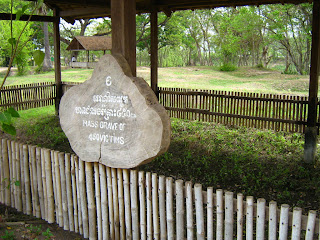
It’s a quiet place, though the sounds of kids playing nearby is a constant reminder that life goes on in Cambodia today. Visitors can walk around viewing the mass graves, many of them labeled. Some are not yet excavated completely.

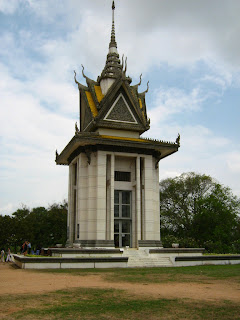
A tower has been constructed on the site and filled with the skulls that have been recovered. The skulls are sorted by age and gender onto shelves that fill the center of the tower and rise at least ten levels into the air.

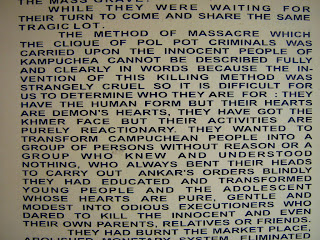
Our entire time in Cambodia, as we moved between cities, interacted with locals, and watched life going by, I could not get over how anyone that I saw who appeared to be my age or older would have lived through the genocidal Khmer Rouge regime. They might have been part of it themselves, or they might have been among the victims – we were told that every family in Cambodia lost at least one or two members to the regime. How does an individual, and a community, move on from such a horror? What does it take to pick up the pieces and start over again? When I looked at Cambodian children, I wondered how much they know about what happened to their parents, their aunts and uncles and grandparents, and how it affects them as they grow up in this so recently devastated country. I had a great deal of admiration for the generosity and kindness of the people we met – that they could be so warm and open-hearted to us, strangers, after having lived through such pain and terror not so long ago.

I was also impressed that the people of Cambodia do not seem to be afraid of labeling the genocide for what it was. Perhaps they’ve realized the economic benefit of doing so, as tourists pay money to see the sites that we did, but I think that many countries would not be willing acknowledge such a black period in their history in such a short time period. I think that anyone who wants to understand Cambodia must go and see these places.
Visiting the museum and the Killing Fields: Consider hiring a tuk-tuk for the day – it will take you to both locations for a reasonable price ($10-15 per vehicle), and wait for as long as you want while you are inside. Each site has its own entrance fee of $2-4. You can hire guides just inside the entrance of the Killing Fields, and they seem to be very knowledgeable.